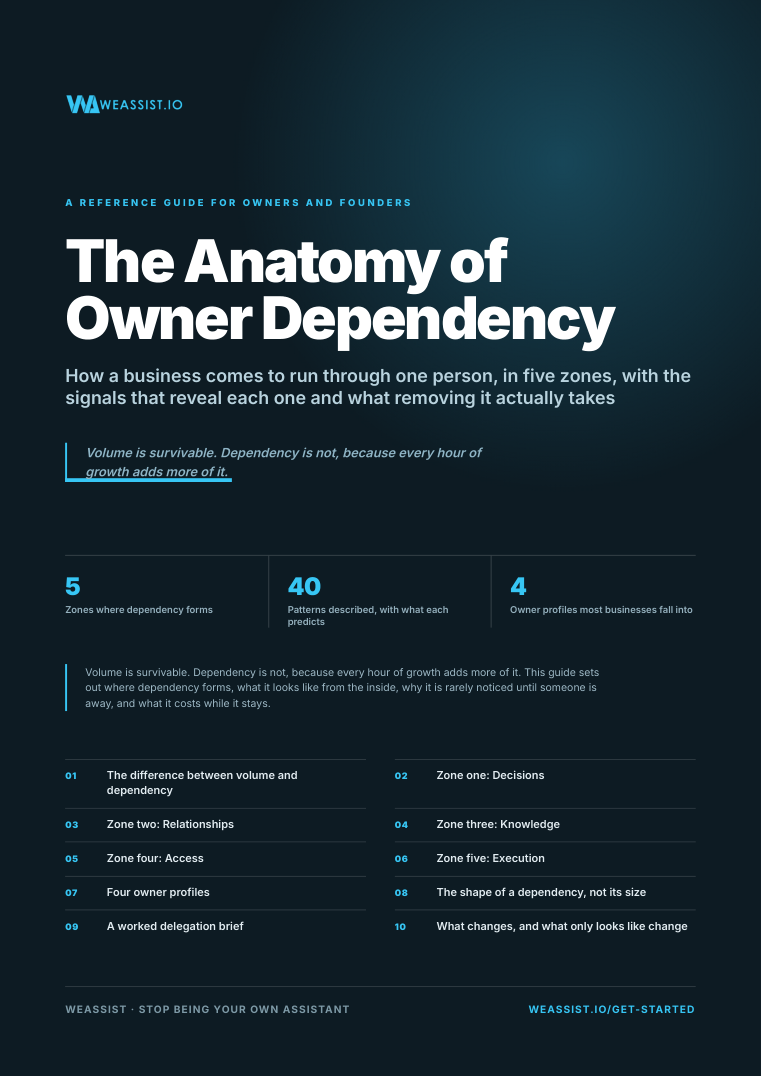
Your business does not have a volume problem
It has a countable set of things that cannot move without you touching them. Volume responds to effort. Dependency does not, because every hour of growth adds more of it. This guide maps where it forms across five zones, the signals that reveal each one, and what removing it actually takes. Inside: five zones and forty patterns, four owner profiles, and a worked delegation brief.
18 pages, PDF, free
WeAssist in numbers
- Applicants accepted
Under 2%
of applicants accepted
- Client retention
98%
client retention
- Average partnership
2.5+ yrs
average partnership
- Time to match
3-4 weeks
first call to final match
Dependency forms in five places, and each one is removed differently
Treating all five as one problem is why most delegation plans stall at the easy zone.
01/Zone
Decisions
The calls only the owner is allowed to make.
Anywhere staff wait on a yes before anything moves. Pricing exceptions, refunds, every hire, ending a relationship. The question is not whether the owner makes good calls, but whether anyone else is permitted to make them at all.
Removed by written criteria and a stated threshold, not by more confidence in the team.
02/Zone
Relationships
The people who will only deal with the owner, by name.
The largest client, the supplier whose terms rest on a personal relationship, the referral who expects to speak to the owner before committing. The most flattering form of dependency, and the most dangerous.
Removed only by introducing a second named human and letting them hold the account.
03/Zone
Knowledge
The process that lives in one head.
The undocumented workaround, the file only one person can find, the pricing logic nobody has written down. Every quote becomes a decision rather than a calculation.
Removed by writing. It is the form of delegation that scales without a conversation.
04/Zone
Access
The logins, approvals and inboxes routed through one person.
A sole password on a weekly system, invoicing that cannot be released, the main business inbox arriving in front of the owner first. The most mechanical zone, and the fastest to reduce.
Unpicked administratively in an afternoon, and a quiet period never fixes it on its own.
05/Zone
Execution
The recurring work still done by hand.
Booking meetings, reading every email rather than the escalations, chasing invoices, compiling numbers by hand from more than one source. The zone owners expect to be worst, and usually is not, because it is visible and gets attacked first.
Counted across a week, those hours are the outline of a job description.
Eighteen pages of patterns you will recognise on sight
Every pattern is set out with what it looks like in practice and what it predicts if it stays.
01/The distinction
- Why volume is survivable and dependency is not
- The second week of a holiday as the only honest test
- Why dependency stays invisible from the inside until someone is away
- Why the five zones fail separately and are removed by different means
02/The five zones
- Forty patterns, each with what it looks like in practice
- What every pattern predicts once it is left in place
- Why each zone forms, and why it was once the correct decision
- What removing each one genuinely requires
03/Profiles and the brief
- Four owner profiles, and what breaks first in each
- Why the shape of dependency across the zones beats its size
- Four verdicts: protect, document, delegate, delete
- A worked delegation brief, line by line, and what each line is doing
- The signals that separate real change from what only resembles it
Written for owners who suspect the constraint is them
Read it if
- Owners who cannot take a second week away without a call on day nine
- Founders whose team pauses a live job to ask what to say
- Operators whose growth has stopped and who suspect the constraint is themselves
- Anyone about to write a job description and unsure whether it describes a role
Skip it if
- Businesses looking for someone to work a task list rather than own an outcome
- Owners who want their dependency mapped for them rather than reading it themselves
- Anyone who needs a person on-site, since an OP works remotely
The actual document, not a description of one
Ten chapters across eighteen pages. Each zone gets a table of patterns, with what each one looks like in practice and what it predicts. The typology chapter sets out four owner profiles and what breaks first in each. The worked example carries a full delegation brief, field by field, then explains what every line in it is doing.
The strongest thirty-day milestone in that brief describes something the owner stopped doing, not something the new person started doing. Activity is easy to demonstrate and proves nothing about dependency.
98% of clients stay. Here is what three of them report.
The smoothest change since acquiring the company
Cassie found the process easy and non-stressful, and describes it as among the smoother changes her business has made since she acquired the company.
Cassiehome improvement
Time back at the end of the day
Heather wanted her time back. She values finishing at a regular hour, and notes that time is the one thing money cannot buy.
Heatherinsurance
Fewer hats, and better sleep
Jordan says his OP came in as a strong performer. That took stress off him, left him wearing fewer hats, and gave him his sleep back.
Jordanhome improvement
Stop being your own assistant
Knowing where the dependency sits is the cheap half. WeAssist recruits, vets and trains a full-time Outsourced Professional for one business. That is not a virtual assistant on a task list, not fractional cover, and not a freelancer. The process runs from discovery call, through client success analysis, talent sourcing and screening, and a joint client and talent interview, to a final match.
Onboarding maps expectations, sets a communication rhythm, configures tools and workflows, and agrees thirty-day performance milestones in writing. After that comes weekly live AI training in automation, prompt engineering and workflow optimisation, alongside scheduled check-ins and optimisation support. If the match is not working, our 30-day rematch guarantee means we find a better fit at no additional cost.
- Families supported
500+
families supported
- Countries
15+
countries